Disclaimer: possible feels ahead.
In late November, 2024, I lost a friend. He didn’t know it, but in many ways he was a big brother, or perhaps a role model for young me. He was a part of our lives when our family shattered and was there for many other turning points in our lives. For the last 10 years or so we didn’t speak much, but he would usually join us at our annual Assembly excursion. Much of my stoic nerdiness I owe to him. I enjoyed learning from him.
One gloomy December night I opened Steam and saw his portrait pop up in some context. “Last Online 33 days ago,” said Steam, innocently. I’d want to say I’ve grown used to the feeling, but even my jaded ass will always feel the silent sting, I think.
On his profile page this was at the top:
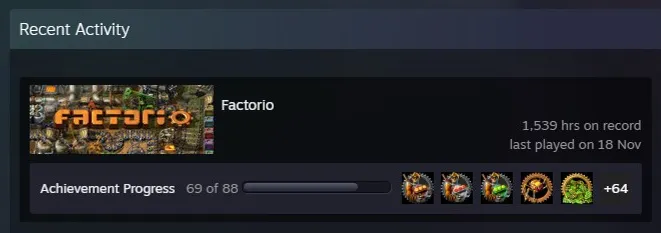
It made me smile. Things that would make him sit down and think and brood in nerdy academic silence were his jam. When Factorio early access launched, I mentioned it to him, but he didn’t have time for it. I’m glad to see he eventually did. According to Steam, he had played it the day he passed.
I loved Factorio for the same reasons he did. Unfortunately, the Space Age expansion launched at a time when I had too many worries on my plate and I didn’t feel like playing games that I knew would consume all of my spare time. I always prefer playing games “vanilla” first, that is, with no modifications or too much help from the internet. For games like Factorio, it’s particularly wonderful to figure out the systems for the first time on your own. The downside is, it takes a lot of time trying not to tryhard things. So, I saved Space Age for another day.
Later in 2025, I was watching my go-to streamer, Preach Gaming, who decided to take on Factorio but without Space Age. To my admiration, Preach always plays games “blind” as well, and his livestream chat is remarkably unhelpful, so no benefits there.
Once Preach got his “Victory!” screen and moved on to other funny internet shenanigans, I felt a void, and a little pang of guilt I couldn’t explain. I took Preach not playing Space Age as a hint. Finally getting around to beating Space Age would be a wonderful way to remember my friend. I had been feeling a bit better, and getting into it might just be what I’d been craving.
Having played Factorio before, I knew Space Age would be great, but nevertheless the sheer genius of the game’s design managed to surprise me. Allow me to gush about it for a while.
Factorio is a masterclass in game design
For the uninitiated, Factorio is a systems-based supply chain logistics construction and management game. It’s not a game for the masses: you cannot just “pick up a controller and have fun”. The art style doesn’t really lend itself to couch gaming either. You are supposed to sit down at a PC and stare and think for hours at a time. The game is clear about the specific type of player it caters to.
The genius of the game arises from its supreme respect for the player. The player character is dropped on a barren planet with an empty inventory. A single introductory popup message exclaims that your purpose is to construct a spacefaring vehicle capable of leaving the solar system. “If you wish to make an apple pie from scratch, you must first invent the universe”, and so on. Off you go, then!
The game comes with a detailed in-game wiki-style knowledge base and an interactive tutorial device to introduce the various systems as they come, but at no point is the player given guidance on how to solve the challenges faced.
The problem is your own making
Space Age does come with some restrictions: the game doesn’t let you just fly off to one of the solar system’s planets; you are required to research the planet first. To begin researching nuclear power, you must have found and mined uranium first, and so on.
Eventually, the time it takes to research new technologies will begin to take too long. The player might plop down more research facilities to speed the progress up until a new problem appears: the “Science Packs” fed into research facilities run dry somewhere. You are not producing enough raw materials to power those extra research facilities you just placed down. This belt supplying iron is already at capacity – what to do?
This is the core of the game. The player now knows their quest is to redesign significant portions of the factory. Perhaps this iron patch would be best served with a new rail connection. Now the iron keeps coming, so you add more steel furnaces. But now your expanded steel department is not being supplied coal fast enough. Layers and layers of little quests, and the game itself provoked the player in no way whatsoever. The game patiently waits for the player to do their thing.
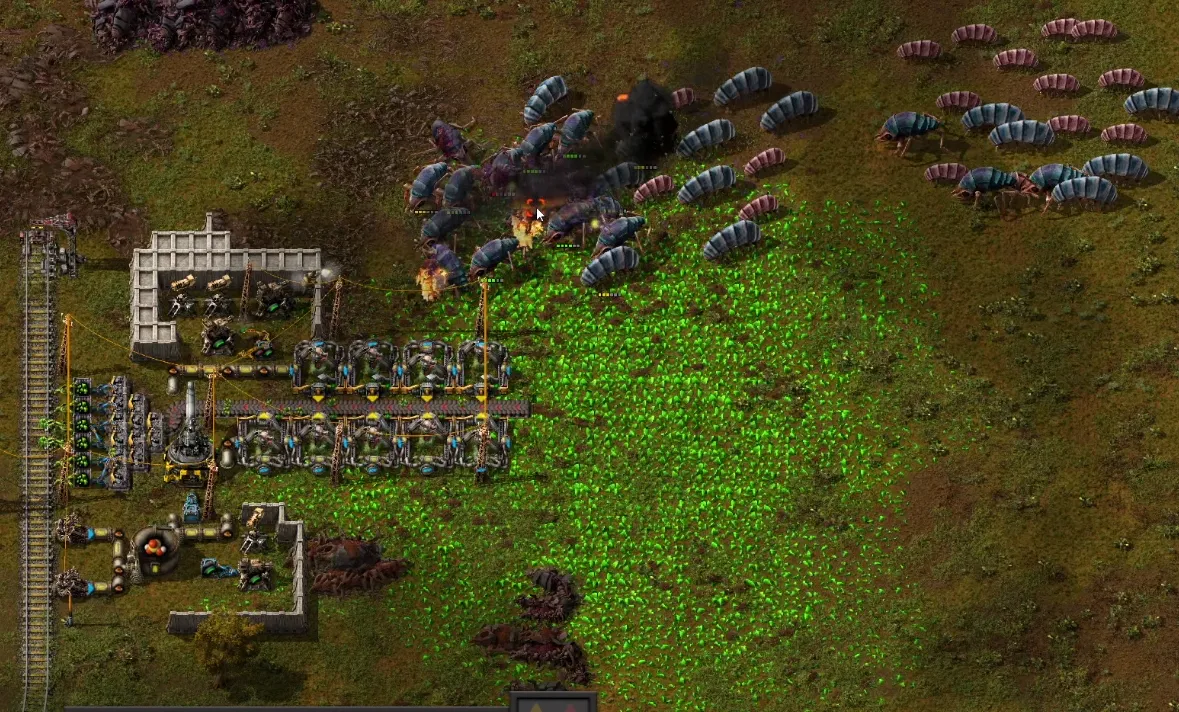
Well, that’s not entirely true. The starting planet has a special system to penalise the player for pollution – for inefficiency. Local aliens will periodically attack the factory, triggered by them inhaling your pollution. This, too, is up to the player to solve: prioritise weapon research or prioritise reducing pollution? Or perhaps YOLO it in the name of not wasting time?
A designed mental load
My favourite system, however, is hidden from plain sight. It’s not something an average player or commentator would notice, I don’t think. I’m talking about a carefully designed… cognitive bucket. You see, as the game progresses, you would think the steady research and system unlocks would just keep adding up until it’s just a giant mess of stressful situations. This is not the case.
Taking iron as an example again, let’s say our player solves their iron supply chain issue. Now they’re producing so much iron it becomes a complete non-issue for the next 10 hours of gameplay or more. One quest has been solved and is available to be forgotten. Every system in the game works like this. Need to defend against the local aliens? Place down 100 turrets around the factory, create a system to automatically feed them bullets, create a new department to manufacture improved bullets, and forget it exists for the next 10 hours.
Even core gameplay takes part in this bucket. At a certain point the player unlocks drone robotics. The robots significantly reduce the stress from having to design around awkward conveyor belts. Belts, which previously were a frequent design issue, are suddenly reduced to convenience items, giving way for more modern problems that need solving.
Another example is power. Early in the game, producing electricity is awkward, very polluting, and takes up enormous amounts of space. An important milestone is unlocking nuclear power, which takes significantly less room, and its fuel cells are consumed at a steady rate regardless of power consumption, so the player is encouraged to use all the power they have. Late-game power is fusion, which is even simpler: it generates enormous amounts of power, consuming fuel cells in relation to power consumption. The player is not asked to revisit the power problem every time; instead, the player is given tools to make old problems less awkward, freeing up even more room in the bucket.
In Space Age this is even more obvious, with the planets, and I can see why they did this. The expansion does not add a whole lot of features to the gameplay of the starting planet, Nauvis – it would simply get too complex. Instead, the planets serve as disparate buckets. Once the player lands on a new planet, it’s almost like the game starts over. You only have the stuff your space boat could bring with it, and you have to work within the limitations of the new planet. For a moment, the player is allowed to forget the starting planet almost entirely: now there’s an entirely new environment to solve. All I have is this pool of lava and geysers of sulphuric acid, and I’m supposed to build a new rocket out of this? Of course, how to construct an interplanetary logistics system to drop supplies from orbit is a minigame on its own. The reward for fleeing each planet is the new research trees their systems and materials unlock.
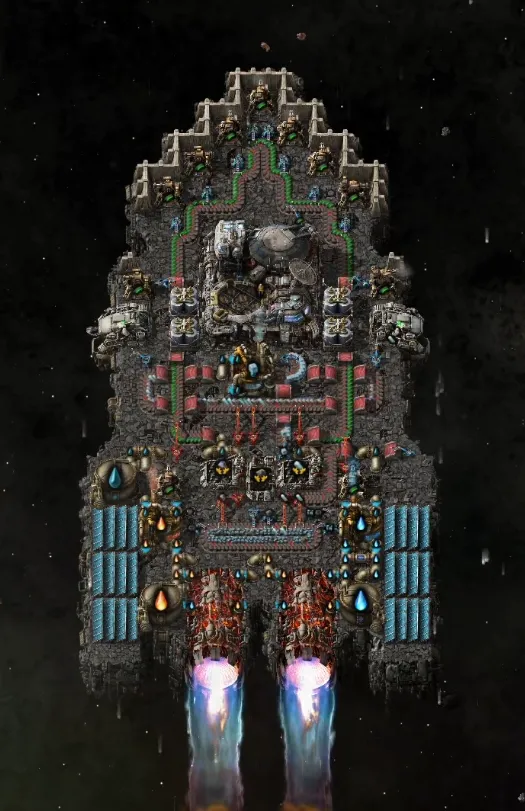
Halfway through the game I learnt to fully trust the developers. Everything was solvable, and nothing would get too complex. Or, well, they trust me to set the boundaries of complexity. The developers knew where the limits of fun were.
Riding into the sunset
I don’t know when I’ll get back to the game, so I did it the long way. I had tinkered with everything and researched every research (excluding infinite “number-go-up” research). Everything must come to an end, however, and I could no longer think of good excuses to prolong my game. It was time to go.
One of the late-game science unlocks is the inconspicuous “Solar system edge” destination, as the game calls it. I set out to build my first serious space boat. I took what the game had taught me: nothing is forcing me to do anything in a particular way, but there are some technologies I have unlocked that I haven’t really needed yet. I take the hint!
I was struck by an idea. If you were to watch streams or YouTube videos about Factorio, you would typically see people doing absurd optimisations or asinine modded challenge runs. As an exercise I briefly tried streaming it, but I am not a production company like Preach Gaming, and me sitting down and thinking in silence is not interesting to anybody. There is no story to speak of, so you don’t see dramatic Let’s Plays either. But what if I told a story? Having streamed a little, I had OBS already set up and decided to just use my default scene to record my attempt at reaching the Solar System Edge.
A short Factorio tale sped up, cut, and edited turned out pretty fun. I’ve been wanting to tell a tale in some other form than overly verbose blog posts. Our D&D game is perpetually on hold, and the video game I worked on last year is still on the table until I figure out how to make it fun, but a little video scratched my storytelling itch perfectly. For people unfamiliar with Factorio, the nature of the game comes across pretty well, too, I think.
I’m nowhere near 1,539 hours, but I consider 210 hours of a blind Space Age run time very well spent. I thoroughly enjoyed myself, but I still feel a kind of sadness. Games like this come out only about once every two decades, and I’m running out of people to enjoy them with. Perhaps I should get into the modding scene one day.
Anyway, this is my final send-off to my friend: fly away to the edge of space, into the furthest reaches of needlessly rational, mildly amused silent academic contemplation.
Thanks for reading & watching!